Hurry!!!! 60 % discount offer to begin 2026 !!!!! Charges even less than $10/ page
IMRaD Structure
Understanding the IMRaD Structure: A Complete Guide for Academic Researchers
Dr. Farheen Choudhary (BHMS, ADPH, MSW, Ph.D)
10/3/20243 min read
Understanding the IMRaD Structure: A Complete Guide for Academic Researchers
Academic writing follows structured conventions that help readers clearly understand, evaluate, and replicate research. One of the most widely accepted formats for research papers across disciplines especially in health sciences, social sciences, and interdisciplinary studies is the IMRaD structure.
IMRaD stands for Introduction, Methods, Results, and Discussion. This format provides a logical flow to research manuscripts and is recommended by most peer-reviewed journals worldwide.
This blog explains each component of the IMRaD framework and how to effectively use it in academic writing.
What Is the IMRaD Structure?
The IMRaD format organizes a research paper into standardized sections that answer four key questions:
What was the problem? → Introduction
How was the study conducted? → Methods
What was found? → Results
What do the findings mean? → Discussion
By following this structure, researchers ensure clarity, transparency, and academic rigor.
Abstract: The Snapshot of Your Study
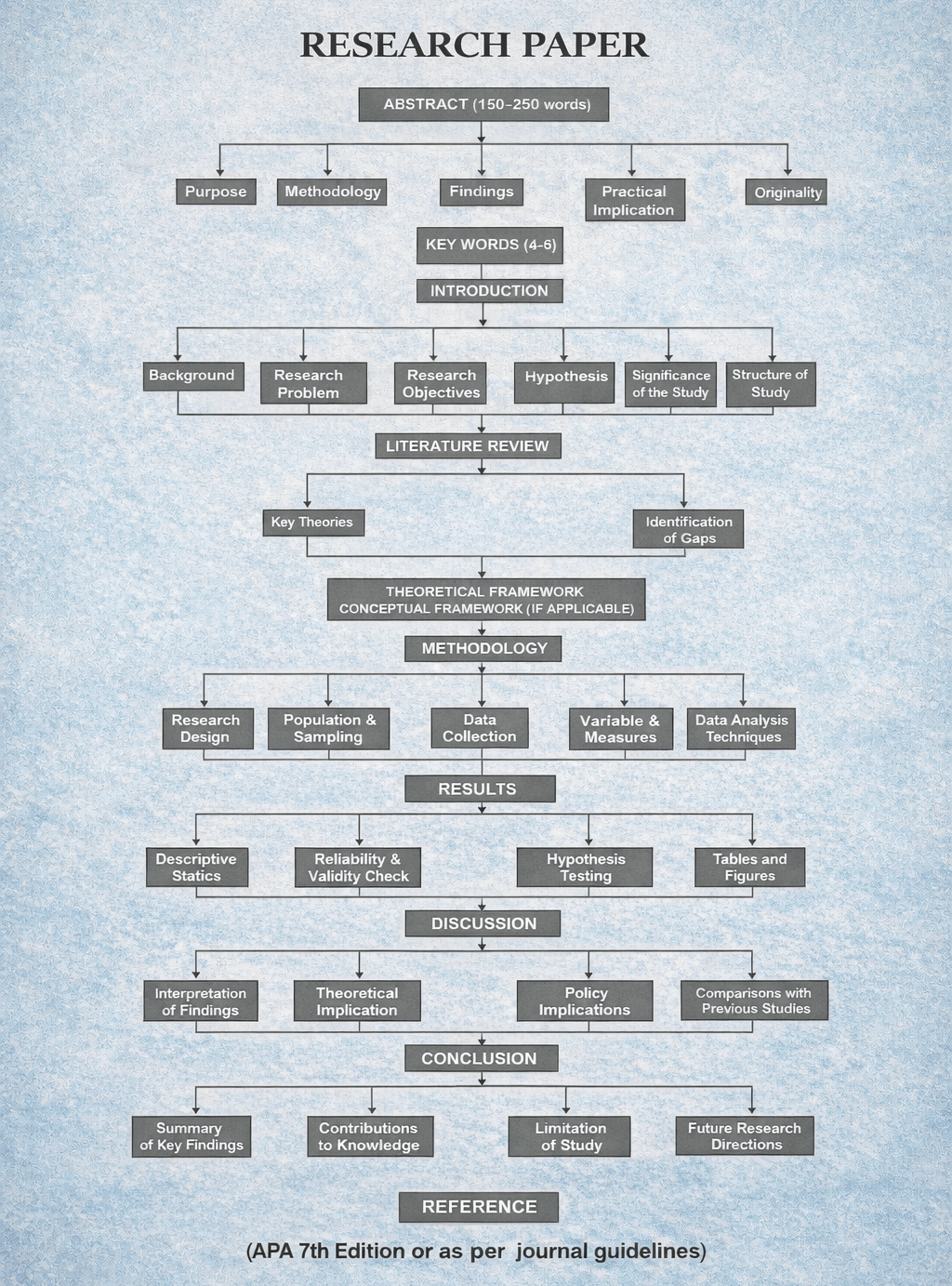
The abstract (usually 150–250 words) is the first section readers encounter. Although placed at the beginning, it is typically written last.
A strong abstract briefly covers:
Purpose of the study
Methodology used
Key findings
Practical or theoretical implications
Original contribution
Many journals now require structured abstracts, especially in health and social sciences.
Keywords: Enhancing Discoverability
Following the abstract, 4–6 keywords are provided. These help indexing databases and search engines locate your research. Choose terms that reflect:
Core concepts
Study population
Methodology
Geographic context (if relevant)
Introduction: Setting the Context
The introduction builds the foundation of your research. It should logically move from general background to the specific research problem.
Key elements include:
Background and context
Research problem
Research objectives
Hypotheses or research questions
Significance of the study
Structure of the paper
A well-written introduction convinces readers that your study is necessary and relevant.
Literature Review: Positioning Your Study
The literature review critically examines existing research related to your topic. It is not merely a summary but an analytical discussion.
This section typically includes:
Key theories and concepts
Major empirical findings
Methodological trends
Identification of research gaps
The literature review justifies your study and leads logically to your research framework.
Theoretical or Conceptual Framework (If Applicable)
Many studies especially in social sciences include a theoretical or conceptual framework. This section explains:
The theories guiding the study
Relationships between variables
Assumptions underlying the research
It strengthens the academic grounding of the study.
Methodology: How the Study Was Conducted
The methodology section ensures transparency and replicability. It explains exactly how the research was carried out.
Common components include:
Research design
Study population and sampling
Data collection methods
Variables and measurement tools
Data analysis techniques
Clarity here enhances the credibility of your research.
Results: Presenting the Findings
The results section presents the outcomes of the analysis without interpretation.
It may include:
Descriptive statistics
Reliability and validity checks
Hypothesis testing
Tables and figures
Results should be presented logically, clearly, and objectively.
Discussion: Interpreting the Findings
The discussion section explains what the results mean in relation to existing literature and research objectives.
Key aspects include:
Interpretation of findings
Theoretical implications
Policy or practical implications
Comparison with previous studies
This section demonstrates your analytical and critical thinking skills.
Conclusion: Bringing the Study Together
The conclusion summarizes the study and highlights its contribution.
It usually covers:
Summary of key findings
Contributions to knowledge
Limitations of the study
Directions for future research
A strong conclusion leaves a lasting impression on readers.
References: Academic Integrity Matters
All sources cited in the paper are listed in the references section, typically following APA 7th edition or journal-specific guidelines. Accurate referencing is essential to avoid plagiarism and maintain academic credibility.
Why the IMRaD Structure Matters
Using the IMRaD format:
Improves clarity and readability
Aligns with journal expectations
Enhances chances of publication
Helps reviewers assess the study efficiently
For PhD scholars and academic writers, mastering IMRaD is a critical step toward successful research dissemination.
Whether you are writing a dissertation chapter, a journal article, or a conference paper, the IMRaD structure provides a reliable roadmap for academic writing. Understanding each section and its purpose can significantly improve the quality and impact of your research.
If you are looking for academic writing support, manuscript structuring, or research consultation, adopting a strong IMRaD-based approach is the first step toward excellence.
Global Scholarly Papers
drfarheenchoudhary@gmail.com
+91 8076138542
9040 Laurel Street
New York, NY 10032